NOVEMBER 29, 2013
by Saïla Ouald Chaib
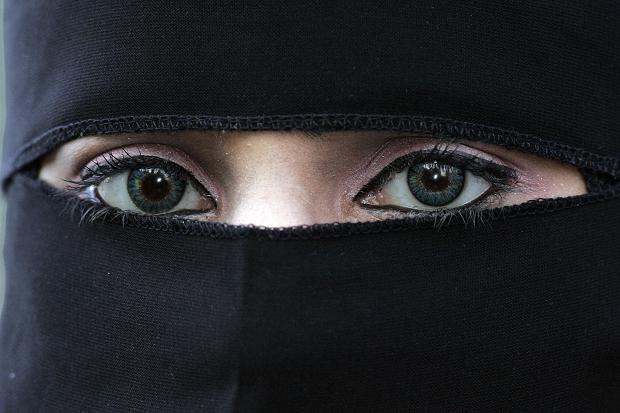
On Wednesday, our research team attended the Grand Chamber hearing at the European Court of Human Rights in the case of S.A.S. v. France, in which we submitted a third party intervention on behalf of the Ghent University Human Rights Centre. The case concerns the French law banning the face veil, a highly debated piece of legislation, which was also obvious from the amount of international press covering the hearing. I will first briefly discuss the content of our third-party intervention and then turn to a summary of the hearing which left a positive impression on us.
Third party intervention of the Ghent HRC in the case of S.A.S.
At the time when the French and Belgian legislation banning the face veil was enacted, no empirical evidence on women wearing a face veil was available. These laws were thus mainly based on mere assumptions. We were of the opinion that the findings of the empirical research conducted by Prof. Eva Brems, dr. Jogchum Vrielink and myself, and the research of our colleagues in France, Denmark, the UK and the Netherlands, who came to similar conclusions, would enable the Court to assess the human rights impact of the face veil bans in a more adequate way. The integral text of our intervention can be found here. We concluded from our empirical research that bans on face coverings are partly based on erroneous assumptions: they do not actually serve their stated purpose, they are disproportionate and they deny procedural justice. We argued that bans of this kind do not only restrict freedom of religion and the private life of the women concerned but are also clearly discriminatory. We also asked the Court to take into account that these kind of bans target a vulnerable group consisting of a minority within a minority and that this legislation is based on harmful stereotypes and stigmas. We also asserted that this kind of legislation should be seen in the context of hostility and discrimination of Muslims in Europe as is documented in various reports of NGO’s and European institutions.
Background of the case
On the day the French ban on full face veiling came into force, S.A.S., a 23 year old French citizen, filed an application against France to challenge the ban. She argued that as a woman wearing a face veil, the ban constitutes a violation of her right to private life, freedom of religion, freedom of expression and her right not to be discriminated against. The Chamber relinquished jurisdiction of the case to the Grand Chamber. In addition to our Human Rights Centre, Amnesty international, Liberty, Soros foundation and Article 19 submitted written observations in the case as third party interveners. Also the Belgian State, the only country apart from France having a ban on face veils, intervened in the Grand Chamber procedure and was allowed to make oral observations during the hearing.
The lawyers informed the Court that although the applicant wished to be present during the hearing, she did not come because of the publicity around the topic and because of the ban in force. Indeed, since Strasbourg is a French city, being present at the hearing would have required the applicant to remove her veil on the way to the Court, otherwise she would be infringing the law and risking a fine.
Arguments of the parties
The agent of France first contested the admissibility of the case, claiming that the applicant did not exhaust domestic remedies and that she cannot claim to be a victim under the Convention since she filed her complaint on the day the law came into force without having experienced direct consequences of the ban at that time. The applicant’s lawyer replied that, since the contested law is unquestionably applicable to her, it cannot be expected that the applicant should first have gone through prosecution by the French authorities before being able to file a complaint before the Strasbourg Court.
Regarding the merits, the agent of the French government started by stressing the general formulation of the legislation, stating that no specific garment is mentioned in the law, neither a specific religion. Nonetheless the government accepted that the law could lead to an interference with the freedom of religion when a face covering attire is worn out of religious reasons. The government subsequently argued, for the reasons mentioned bellow, that they had not exceeded their margin of appreciation and that the law and the sanctions are proportionate to the aims pursued.
First of all, France argues that individuals should be “identifiable when required” in order to avoid identity fraud and to protect the security of individuals and property. A second aim invoked by the government, and clearly the most important one, is the aim concerning “the minimal requirements for living in a society”. The French agent explained that the ban aims at preserving relations between human beings, the so-called “vivre ensemble” and that individuals are required in the public space to interrelate with one another. The French Government further stated that it values the expression of religious diversity in the public sphere, but that this must be compatible with principle of ‘secularist pluralism’. Finally, France argued that the ban aims at preserving equality between men and women and at defending the dignity of human beings.
As to the right to private life, France argued that the ban concerns the public space and not the private sphere and that it does not see how the ban could affect aspects of private life such as the right to privacy and physical integrity. Concerning the discrimination claim, France argued that the ban is not discriminatory on the basis of gender, on the contrary, it aims to fight gender discrimination. Neither did it consider that the law discriminates Muslims, since the face veil is not a widely accepted practice within the Muslim community.
The lawyers of S.A.S. on the other side argued that the ban on face veils is disproportionate and advocated for a narrow margin of appreciation in the matter. They maintained that in order to ensure proportionality, the Court should consider the legitimacy of the state’s assumptions instead of granting them a wide margin of appreciation. Accepting a wide margin would, according to the applicant’s lawyers, entail a danger that “the fear of majorities would overrule the rights and freedoms of minorities”. Concretely, they argued that, since the law concerns an intimate aspect of one’s identity and since women wearing a face veil are part of a small vulnerable group that was hardly consulted on the matter, the Court should not accord a wide margin of appreciation to the State. The lawyers also contested that the law does not aim to target Muslim women wearing the full face veil. They argue that though neutral on its face, the law has a disparate impact on Muslim women. Therefore they allege a violation of article 14 of the Convention, stating that the ban discriminates Muslim women on the basis of their gender, ethnicity and religion. In conclusion the applicant’s attorney said that the ban consists of a “disproportionate measure towards a disadvantaged minority group with no evidence of a threat to social order, equality, liberty or fraternity” and that the ban only aims at offering comfort to the majority.
In the second part of their oral observations the applicant’s lawyers confronted us with the absurdity of the ban. They referred to the exceptions on the ban where covering the face is still allowed. People are allowed to cover their face during festivities, “for party reasons” such as at “le Carnaval de Paris“, while the applicant is not allowed to cover her face for religious reasons. The law also foresees an exception for covering the face in places of worship such as mosques. However, this would mean that the applicant would offend the law as soon as she opens her front door, until she reaches the door of her mosque. The lawyer also referred to the willingness of the applicant to compromise. She is willing for example to uncover her face when needed for identification. Finally, the applicant’s attorney pointed to the “perverse effect” of the law, arguing that the law led to more hostility and intolerance against women wearing a face veil.
Judges ask pertinent questions
A very interesting part of the hearing was the part where the judges asked questions to the parties. The French Judge, André Potocki, first asked to the applicant what would be, according to them, a less restrictive measure instead of the current general ban. He further asked the French government whether, in light of the aim of public safety, a general ban would not be disproportionate. A next question asked both by Judge Potocki and Judge Møse, concerned the aim of “the minimal requirements for living in a society”. They asked how the government would situate this aim, within the list of legitimate aims mentioned under paragraph 2 of article 9. Another question concerned the concept of human dignity. The French judge asked whether it is up to the state to say that a behavior that is adopted freely goes against the dignity of that person. And he also asked France to explain how a face veil would affect the dignity of people who come into contact with women wearing a face veil, as France argued. Judge Møse further asked whether the findings concerning tensions that women wearing a face veil nowadays encounter is not contradictory to the aim of social cohesion. Judge Nussberger finally asked whether in case the applicant would wear a veil of a finer material with which her facial features would be recognizable as she herself proposes as a matter of compromise, whether that behavior would be covered by the ban.
We left the hearing in a positive spirit. Not because we think that the outcome in this case will be positive -we can fairly say that the outcome is totally unpredictable— but because, following the questions asked by the judges we are hopeful that finally the issue of the full facial veil will, during the deliberations, be discussed in a thorough manner from a human rights perspective. We realize that this is not an easy issue to deal with. It led to huge discussions in the political and societal sphere, discussions that were very often one-sided and stigmatizing. When we assume that a face veil is imposed on women, it is just absurd to fine them and thus punish them with the aim of protecting them. This would be a case of domestic violence for which other legal tools already exist. But if we look at the issue from the perspective of women who choose to wear a face veil, such as Mrs. S.A.S. and the women mentioned in the French, Danish, Dutch and our Belgian research, the question that should be asked is whether the general public’s discomfort with- or fear of face veils or of the women wearing them justifies infringing these women’s fundamental human rights. Now it’s up to the Court to answer that question
Source: http://strasbourgobservers.com/